

Last updated: 16 October 2026
Short answer: choose a ratchet belt if you want a precise fit — adjustment in steps of about 5 mm instead of 2.5 cm — and no favourite hole that stretches over time. Choose a classic pin-buckle belt if you want to wear it straight out of the box without trimming and prefer a traditional look. Both work with a suit at a width of 3–3.5 cm.
What is the difference between a ratchet belt and a classic belt?
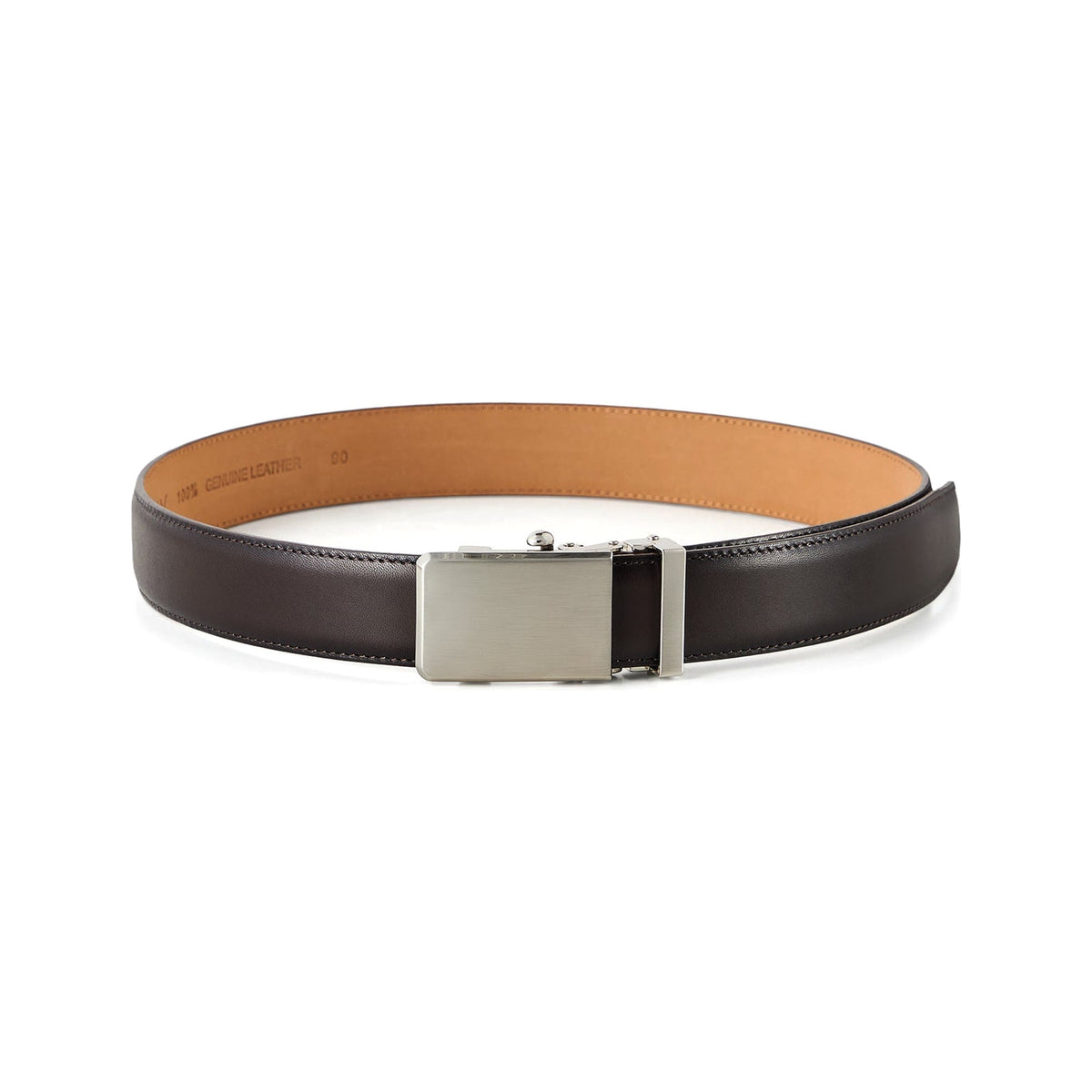
A ratchet belt (also called an automatic or track belt) has no holes. A toothed track runs along the inside of the strap and the buckle locks onto it at every tooth. A classic belt usually has five holes about 2.5 cm apart and a frame buckle with a pin that goes through one of them.
| Feature | Ratchet belt (no holes) | Classic belt (holes) |
|---|---|---|
| Adjustment | Steps of approx. 5 mm, many positions | Usually 5 positions approx. 2.5 cm apart |
| Fit after purchase | Trim once to your waist (about 2 minutes) | Usually ready to wear; sometimes needs an extra hole |
| Adjusting during the day | Smooth: push the strap in, or press the release lever under the buckle | Unbuckle and move the pin to another hole |
| Wear | No holes to stretch | The most-used hole stretches and deforms the leather over time |
| Look | Flat plate buckle, no pin, no visible holes | Traditional frame buckle with a pin |
| Buckle | Usually clamp-mounted, so it can be removed and replaced | Depends on the model: stitched, riveted or screwed |
| Returns | A strap trimmed to length counts as altered — try it on before cutting | No trimming, so easier to return unused |
When is a ratchet belt the better choice?
- When a classic belt is always “between holes” — one too tight, the next too loose. Steps of about 5 mm fix that.
- When you sit a lot — at a desk, in a car, on long journeys. Loosening by one notch takes a second.
- When you want a clean, minimal look — a flat plate buckle with no pin and no holes looks tidy under a jacket.
- As a gift — the length is set after purchase by trimming, so you don't need to know his exact waist.
When is a classic belt the better choice?
- When you don't want to trim anything — a classic belt in the right size is ready to wear.
- When you like a traditional pin buckle — for example with western or workwear outfits.
- When keeping the option to return matters — a belt that doesn't need trimming is easier to send back untouched.
Ratchet belt with a suit
With a suit, choose a belt 3–3.5 cm wide in the colour of your shoes: black with black shoes, brown with brown. A ratchet belt works especially well here because the flat buckle with no pin sits smoothly under a jacket. The most formal pairing is black leather with a brushed silver or gun-metal buckle.
Ratchet belt with jeans
With jeans and chinos, brown leather at about 3.5 cm wide fits most belt loops. A gun-metal or carbon-pattern buckle looks less formal than polished silver and suits casual outfits better.
What to look for when buying a ratchet belt
- Leather: look for full-grain leather rather than split or bonded leather — it lasts longer and ages well. See full-grain vs genuine leather.
- Width: 3.5 cm is the versatile width for both suit trousers and denim.
- Mechanism: a metal buckle with a release lever and a track that holds securely.
- Length before trimming: choose by trouser size; between sizes, go longer.
- Warranty and returns: check how long the shop covers the mechanism and what happens if you return a trimmed belt.
Frequently asked questions
Is a ratchet belt formal enough for a suit?
Yes, if it is full-grain leather with a restrained buckle. From the outside it looks like a smooth plate buckle with no pin and no holes, which reads tidier under a jacket than many frame buckles.
Can you shorten a ratchet belt?
Yes — trimming is the normal way to fit it. Remove the buckle, cut the strap at the buckle end with sharp scissors and refit the buckle. Step by step: how to cut a ratchet belt to size.
What size ratchet belt should I buy?
For Harrow belts: 90 cm (S) for a trouser waist of approx. 75–85 cm, 100 cm (M) for 85–95 cm, 110 cm (L) for 95–105 cm and 120 cm (XL) for 105–115 cm. Between two sizes, take the longer one and trim the excess.
Do ratchet belts break?
What usually fails first is weak leather rather than the mechanism, so choose full-grain leather and a shop with a clear warranty. Harrow belts carry a 36-month warranty against manufacturing and material defects, on top of statutory consumer rights.
Harrow ratchet belts
Harrow Collection is a Polish leather goods brand. Our ratchet belts with no holes are full-grain Italian leather lined with nubuck, 3.5 cm wide, with an automatic buckle that adjusts in steps of about 5 mm — in brushed silver, gun metal or carbon. Every belt arrives in a rigid gift box with a magnetic closure, and you have 60 days to return an untrimmed belt.